
The Fourth Frontier, Part 2: Paul McNiel on The Wagon Box and the Fourth World
Theorizing the Fourth Frontier with one of the most singular personalities of Internet 4.0

This is part two of the Fourth Frontier series. You can read part 1 here.
We recorded this episode after the tour of Paul McNiel’s place. It was two days after the third annual homesteading symposium at the Wagon Box—my first time meeting Paul, not to mention all those other lovely people.
We sat inside a 1970 single-wide trailer that included a hand-built table the size of a small banquet hall on a covered porch, a tea station that had taken over the kitchen counter, a giant open box of nuts on a side table, and around six hundred books stacked on a coffee table. It felt more like a hobbit hole than your typical trailer. Outside, Paul’s goats frolicked joyously.
I found out while staying at Paul’s Wagon Box that the Guardian had run a hit piece earlier this year framing his operation as a hub for the dissident right. In reality, like so many fourth places, it’s a real place for real people, with a lot of heterodox guests. Apparently the Guardian found that threatening. Something I found interesting in that article was when they said, “Property records and data brokers indicate that McNiel or LLCs controlled by him have bought and sold dozens of properties – many of them trailer parks or similar sites for low-cost housing – in at least three states.”1 Why would the Guardian bother to mention this? They don’t make a habit of explaining where most of the people they cover get their money—notice that they don’t tend to tell you which lobbies or billionaires have bought out their darling politicians. I think they were trying to call him a “slumlord” without coming right out and saying it. After the time we spent together though, I can say that Paul is anything but.
The trailers there were well kept and hosted a lot of families. They call each other by name. The next door neighbor comes by for coffee every day. Paul does not live like someone fleecing the working poor. He lives like someone who decided the whole package deal of a mediocre four-hundred-fifty-thousand-dollar house was a sucker’s bargain, opted out, and is now trying to model the alternative.
What Paul calls the alternative is the Fourth World. It connects well with his “Fourth Places,” which is the name for the specific physical nodes where the digital gets to ground out and build what I call “temporal sediment” at a place with enduring character and roots.2 Paul’s Wagon Box is one of those Fourth Places, as is Theory Underground’s base of operations at McKerracher Family Farm. These are the nodes of Internet 4.0.3 What follows are elaborations and reflections on some of the stuff we talked about in the episode, which you can also listen to here.
Priorities in Order
Paul grew up deep in the woods of Quebec in a town of about twenty-seven people. You could only get to it by train. His parents were academics. He was raised poor and did not know it until they came down to the States and lived in a trailer park, where he found out for real. His dad is from North Carolina, and Paul went to high school there, then bounced around widely, before ending up in the Mountain West about a decade ago. He has been a small farmer, a soldier, the operator of a one-man gas station on the Alaska Highway, and now the proprietor of the Wagon Box, a Fourth Place at the foot of the Bighorns where indie writers, philosophers, homesteaders, and curious passers-through come for events that he runs several times a year.
The single-wide where we talked is one of the trailers in his trailer park. He lives there. The library he is building there is epic. The table in his dining room is one Paul built himself. A truly remarkable piece, the kind made for fellowship.
Paul had figured out the math early: the vast majority of his peers were strapping themselves into mortgages on mediocre four-hundred-and-fifty-thousand-dollar houses so that they could work themselves to death and never really experience freedom. Instead, he spent twenty thousand on the trailer, half that on the library, and some serious sweat equity on the table. He was, by his own count, way ahead of the game. I couldn’t agree more.
The two most useful objects for “a man of culture and a man of, you know, society, family, friends,” are a big beautiful table and a big beautiful library. Everything else is negotiable. The trailer is a container. You can spend the difference, or you can save and build the timber-frame stone house in the country in fifteen years, but in the meantime you are not strapped, you are not commuting four hours, you have time, and you have your books.
Paul is not just out here on a personal hermitage with his goats. He owns the park and helps the people who live there. He has thoughts about how to run it. He has a method.
“As soon as I buy a trailer park, couple things. I asked the previous owner who are the three total dirtbags that just menace the community and society at large, and they immediately know who they are. And it’s like, why did you let them stay here? I drive them out. Then I ask, who’s the sheriff in town? Who’s the dude that, like, is the first one there with the chainsaw when the tree falls? Who’s the mom that’s always going around hollering at people about driving too fast in the park? All right, then I deputize them. You have the blessing of the park owner to keep order in this place.”
The community already has the people in it who keep order, they just need permission and recognition. The Guardian writer somehow assigned to all this the idea of buying and selling cheap properties and stopped there. Paul didn’t seem too bothered by the hit piece. He’s proud of what he’s built, which is a part of what he theorizes as “the Fourth World.”
The Fourth World
To understand the fourth world we have to speed run the first, second, and third worlds. We’ve all heard of first-world problems. Paul wants you to also consider first-world advantages, and what gets lost when pursuing those.
The first thing lost in pursuit of first-world living is the Third World itself, which Paul described as such:
“When I talk about Third World, I’m talking about cheap housing. I’m talking about close housing, a lot of kids running around, a lot of animals running around your yard, a lot of free time. The old guys are playing dominoes. The kids are running around a lot closer and more integrated family-and-work scenario.”
The second thing lost is the Second World. Paul said:
“The Second World, the neglected Soviet system. Major problems. Obviously collapsed for good reasons. But some of the things that were part of it, I think, can sort of be rehabilitated. A sense of committing to a larger, broader group, and having some kind of overarching plan with that group. Some kind of communal buy-in. And I think any healthy community has that to some degree.”
The Fourth World is the synthesis. First-world advantages where they actually matter, second-world communal buy-in and overarching plan, third-world down-to-earth housing with kids in the yard, dominoes on the porch, free time, and integrated family-and-work life.
It’s not minimalist chic, it’s minimalist in the ways that matter. Cobbled together, deliberately, by people who looked at the consumer menu and noticed that what was on offer in any single column had been edited down by someone who was missing the point of life.
Paul’s trailer is one practical demonstration of what that synthesis can look like at the household scale. The Wagon Box is one practical demonstration of what it can look like at the institution scale. He recently came back from the northern Shetland Islands, where the calendar of annual celebration provides a year-to-year structure that does some of the second-world work without the central planning of a regime, and he has been chewing on that as another piece of evidence that what he is after is real and recoverable.
Paul’s concepts are grounded in the kind of practice that only pioneers of the Fourth Frontier could meaningfully develop or apply.
The Foothold and Pathways to Exit
In our episode, I told Paul about the Foothold—something I’ve mentioned in passing on my YouTube channel but that most people will have missed. Years ago I built a little twelve-by-eighteen house on a double-axle flatbed trailer with my friend Bryan and the help of an architect professor named Ty.
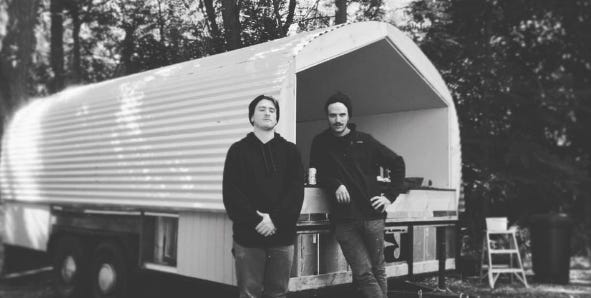
It cost me eighteen hundred dollars and a summer of work, but then I got to live in it for several years. I called it my foothold, because when you are climbing a cliff there’s nothing more helpful than a good foothold. What this alternative living situation unlocked was a foothold of money and timenergy saved, wrested from the system, so that I could try something different.4
The whole episode circles this idea: we want the Good Life, but the system won’t allow it without making some sacrifices and cutting corners. Most people, by Paul’s own observation, are above-average-IQ-capable and broke on time and on money simultaneously, in the richest period in the richest country in human history. Something is wrong when an average competent adult cannot afford a real life by working a reasonable amount of hours.
What we are both doing, in different ways, is trying to build pathways out, and trying to make those pathways legible enough that someone could actually choose them. Paul has a thought experiment about this:
“I asked these two guys who has more total reckless freedom: an eleven-year-old in my trailer park, or an eleven-year-old in the royal family who’s gonna end up becoming King of England? And one hundred percent the trailer park guy. He can do whatever he wants, man. The guy who’s gonna become king, he gets told how to eat, how to talk, how to dress. But he’s gonna have immense power. He’s gonna have immense vistas open to him: what he can do, what he can think, how he can travel. Whereas this guy running around doing whatever he wants is just gonna have such a narrow, limited world.”
The trailer-park kid has more local-scale freedom. The royal kid has a global horizon with less wiggle room. Both forms of freedom come with their own constraints. We want another option.
People who organize their entire lives around the slogan be ungovernable have, Paul says, “absolute toddler mentality,” and they tend to mistake the absence of structure for the presence of freedom. The horizon shrinks. The vista closes.
What is needed is not less structure. What is needed is structure that someone can actually opt into without being mocked or pitied. The trick of normalization, Paul pointed out, is that it can lower the bar for whatever it normalizes, no matter how strange the bargain. He said,
“It’s very hard for me to convince a middle-class buddy with two kids to live in a single-wide trailer. Very easy to convince him at eighteen, nineteen, twenty, to live in a crappy dorm with three other guys rolling around in pizza boxes, spending sixty thousand a year to play beer pong. Or take the military. Convincing a few families to go in on a piece of property is mind-blowing, and yet thousands of families do this thing where the wife and kids live in crappy housing, the husband’s gone all the time, he’s told what to wear, they fly him away for months at a time for Lord knows what. If anybody proposed it outside the military, nobody would go for it. But it’s some kind of normalized package deal. It’s got the brochure, the labeling, the insurance, the pension. We know what this is.”
The brochure does enormous work. People will accept any number of indignities if those indignities arrive with letterhead and social legitimacy recognizable to the grandparents.
The Fourth World, Internet 4.0, and what TU is building are all in the business of crafting brochures for a more reasonable and fulfilling way of life—we’re marketing the future itself.
The way I have been talking about this for the last ten years is the need for a new symbolic position—and really, a plurality of new symbolic positions. Metamodernism is one academic attempt to do this, mostly from inside the university. Dugin’s Fourth Political Theory is another, mostly from inside Russian state-adjacent circles.5 My critique of both, as it pertains here, is that a new symbolic position cannot be cooked up by people whose habitus is fully shaped by the institutions they would need to displace. A new symbolic position requires trailblazers, pioneers, builders, and cultivators.
Internet 1.0 Through 4.0
Now the part about the internet. Lots of people homestead or save money by living in trailers. What’s crucial is that we’re all, in our own ways, pioneering a new approach to the internet—one that draws off the previous iterations without getting stuck in the past.
Internet 1.0 was the wild west. Anonymous handles and GeoCities pages. The first generation of online people, before Wikipedia, before social platforms, before the rise of the giants. Internet 2.0 became the social web, e.g. MySpace and then Facebook. People putting their faces on profiles, sharing their poetry or pictures of food. Internet 3.0 is the blockchain wave. Web3, encrypted continuity, divestment from the platform giants.
Some of my friends in the Innovation Collective up in Coeur d’Alene, with Nick Smoot, are doing a lot of work in this register, building social networks on blockchain rails. Paul is friends with Balaji and follows that world with interest. In this episode recording we both share our ambivalences. There is something there, but there’s also a lot of vaporware. The promise of permanence and continuity is enticing, but suspect.
What I had figured out, after three years of an international book and podcast tour across more than twelve countries and twenty-two cities, is that none of this works without a real place under your feet. Touring is great. The underground music scene vibe of long van rides and friends’ couches is fun. Even as a new father I suspect I’ll still be doing some of that, but I won’t pretend it is enough. Without a place under your feet that will be there in five years, and twenty years, and fifty years, you’re basically living in Walmart.
Internet 4.0 is the phase that gets serious about places, not just spaces. It is the name I have given to the next phase of the Cyber Era, in which digital communities re-ground themselves in physical places that have personality and durability, that are owned and run by a person, family, or community rather than a platform or a corporation.6 Fourth Places extend what Ray Oldenburg called the third place by adding the condition of chronic embodiment: a physical site visited repeatedly, over years, by members of an online community.
McKerracher Family Farm is a Fourth Place. The Wagon Box is a Fourth Place. The CCCRU studio in Toronto is a Fourth Place (Jreg & Art Chad). Pierre d'Alancaisez & Verdurin’s Verdurin in London is a Fourth Place. The Maurin Academy’s Farm in Kansas City is a Fourth Place. Each has its own personality, founders, network, and intellectual center of gravity. What they share is the refusal to accept de-worlded relationships as the final form of human connection, and the willingness to do the hard work of building hardware for online communities that were never going to incarnate on their own.
In close
I realized this post could go on forever. We talked about the idea of cultivating some kind of cultural hegemony while at the same time sustaining the grounds for plurality; we talked about cops, Karens, and constables; and then why Star Wars is better than Star Trek, and how I presented my story as that of a prodigal son. That last theme is crucial to how I’m theorizing first and second deliberate parents and the concepts of radical grace and responsibility—stay tuned for more on that later.
Two months after my episode with Paul, our mutual friend Matthew Stanley accepted the role of operations manager at the Wagon Box. Stanley is a regular at TU’s Philosophy of Stewardship Seminar, as well as Intro to Theory—both of which he has given guest lectures at. While I am on paternity leave, Stanley is teaching a deep dive into the theory and history of the Deep State this June for the Theory Underground membership.7 Now he is doing software-development management for Internet 4.0 at one of its most iconic Fourth Places.
These kinds of places are for people who are sick and tired of just doing stuff in the same old institutions or on dying social media sites. These kinds of places are for people for whom a hit piece by The Guardian functions more like a badge of honor and sign of credit than anything else. Reclaim your life, spend time with real people, and do it somewhere with personality grounded in nature.
We’ve got something along these lines coming up soon: McKerracher Family Farm is hosting TUCON26 and CANONFEST this August 27th through 29th. You can apply at this link. Three days spent camping at a regenerative family farm in the Inland Northwest might be just what’s needed. We’ll have a Canon: TCG tournament, talks, live podcasts, farm-to-table dinners, a lake day, followed by a fire at night. We’d love to see you there.
Thanks for reading
Subscribe to Theory Underground to catch future installments in the Fourth Frontier series, and to hear about upcoming IRL events at McKerracher Family Farm and across the constellation.
Notes:
Jason Wilson and Ali Winston, "Remote Wyoming Vacation Lodge Emerges as Haven for US 'Dissident' Right," The Guardian, May 24, 2025, https://www.theguardian.com/us-news/2025/may/24/wyoming-vacation-lodge-rightwing.
David McKerracher, "The Role of Temporal Sediment and the Multifaceted Self" (paper presented at the 2015 Pittsburgh Continental Philosophy Network Conference, "(un)commons: theory and public space," Duquesne University, Pittsburgh, PA, September 25, 2015).
For the conceptual architecture, see David McKerracher, “The Fourth Frontier: Internet 4.0, Fourth Places, and McKerracher Family Farm as the Base of Operations,” Theory Underground, March 6, 2026, https://theoryunderground.substack.com/p/the-fourth-frontier.
On the foothold concept and its development through the early years of TU, see David McKerracher, Timenergy: Why You Have No Time or Energy, foreword by Slavoj Žižek (Theory Underground Publishing, 2023).
Aleksandr Dugin, The Fourth Political Theory, trans. Mark Sleboda and Michael Millerman (London: Arktos, 2012). On metamodernism, see Hanzi Freinacht, The Listening Society: A Metamodern Guide to Politics, Book One (Metamoderna, 2017).
On the Cyber Era as a periodization, see Norbert Wiener, Cybernetics: Or Control and Communication in the Animal and the Machine (Cambridge, MA: MIT Press, 1948). On the platform-vulnerability problem and the case for re-grounding, see Art Chad, “You’re Running Out of Time to Hide,” 1000 Singularities , December 2025, https://artchad.substack.com/p/youre-running-out-of-time-to-hide.
I talked with Matthew about his upcoming course in this video here: